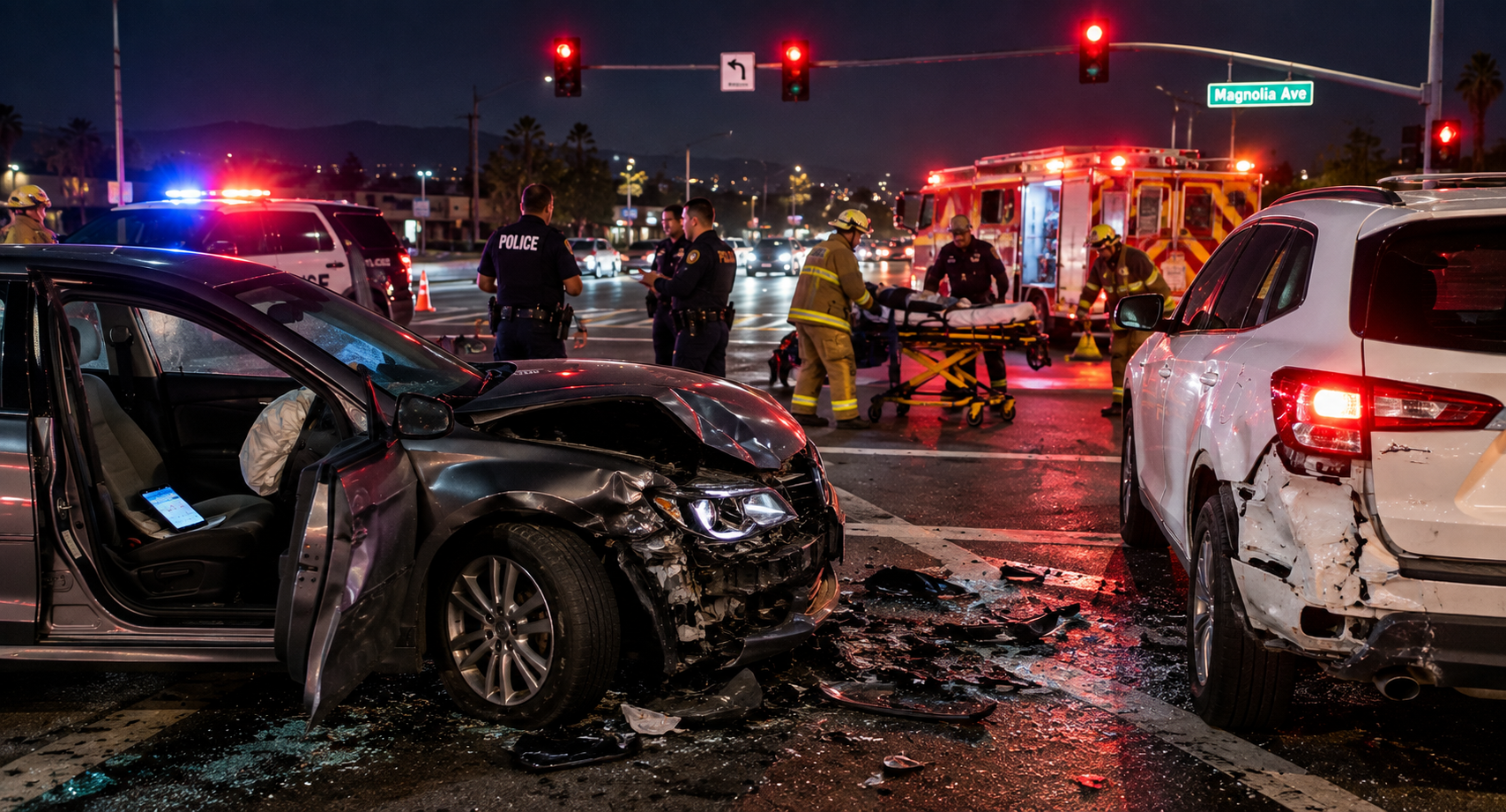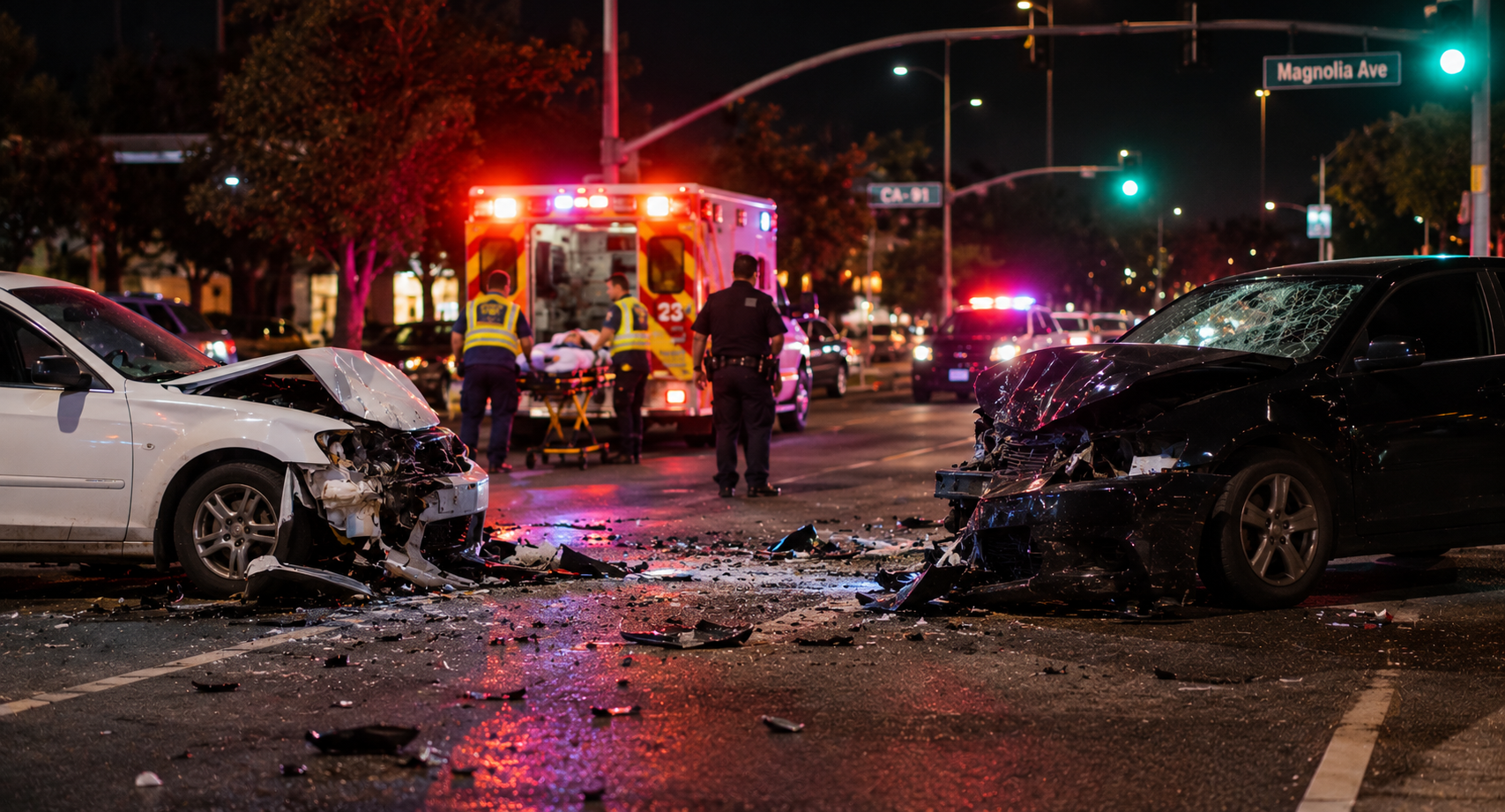
Speeding and reckless driving accidents in Riverside County can produce severe injuries because higher speeds give drivers less time to react and can increase the force involved in a collision. A crash caused by excessive speed may happen on a freeway, major roadway, residential street, intersection, or parking area.
Speed is not always obvious after a collision. A driver may deny speeding, while physical evidence at the scene may provide additional information about what happened. Skid marks, vehicle damage, roadway conditions, surveillance footage, witness statements, and other evidence may help investigators reconstruct the crash.
The issue is receiving renewed attention locally. In October 2026, the Riverside County Sheriff’s Office announced a $1.442 million California Office of Traffic Safety grant supporting enforcement and education programs aimed at reducing dangerous driving behaviors. The program includes enforcement focused on speeding, failure to yield, stop-sign and red-light violations, and improper turns or lane changes. Riverside County Sheriff’s Office information about the speeding and reckless-driving enforcement program provides additional details.
The City of Riverside has also implemented a citywide speed-limit reduction program after reviewing roadway conditions, traffic patterns, pedestrian activity, crash history, and speed data. The city reports that 135 roadway segments are receiving speed-limit reductions of 5 to 10 mph, while 63 roadways have been designated as Safety Corridors. City of Riverside Safe Speeds program provides information about the local initiative.
What Counts as Speeding?
 Speeding does not necessarily mean driving far above the posted speed limit. California law also requires drivers to operate at a reasonable and prudent speed under the circumstances.
Traffic, weather, visibility, road conditions, pedestrians, construction activity, and other factors can affect what speed is appropriate in a particular situation.
A driver may therefore be traveling below the posted speed limit and still be driving too fast for the circumstances. Conversely, a driver traveling at or near the posted limit may need to reduce speed when conditions require greater caution.
California Vehicle Code Section 22350 establishes California’s basic speed law. The California Legislative Information website provides the statutory language.
How Speeding Causes Accidents
Speed can affect several aspects of driving. A faster vehicle generally travels farther before the driver can respond to an unexpected hazard. Higher speeds can also make it more difficult to stop safely and may increase the severity of a collision when impact occurs.
Speeding may contribute to:
- Rear-end collisions
- Intersection crashes
- Lane-change collisions
- Loss-of-control crashes
- Pedestrian collisions
- Bicycle accidents
- Motorcycle crashes
- High-speed freeway collisions
- Single-vehicle crashes
The National Highway Traffic Safety Administration identifies speeding as a major traffic-safety problem and explains that speed affects both the likelihood of a crash and the severity of injuries when a crash occurs.
The City of Riverside’s current traffic-safety program reports that 2,806 collisions were recorded from unsafe speeding between January 1, 2021, and December 31, 2025.
Speeding at Riverside County Intersections
Intersections can become particularly dangerous when drivers approach too quickly. A speeding driver may have less time to recognize a changing traffic signal, a vehicle turning across the roadway, or a pedestrian entering a crosswalk.
The City of Riverside’s Local Roadway Safety Plan identified improper turning, unsafe speed, other improper driving, and violations involving traffic signals and signs among the recorded collision factors in its 2017-2022 analysis.
These factors can overlap. For example, a driver traveling too fast may also fail to stop for a red light or make an unsafe turn. Determining what caused a particular collision requires looking at the circumstances of that crash rather than assuming that one factor explains everything.
Speeding on Freeways and Major Roads
Highway crashes can become especially serious when vehicles are traveling at high speeds. A driver who suddenly changes lanes, follows too closely, or loses control can create a chain reaction involving multiple vehicles.
Riverside County includes major transportation corridors carrying passenger vehicles, commercial trucks, motorcycles, and other road users. Congestion can also produce sudden changes in traffic speed, making it important for drivers to maintain appropriate following distances.
Our article about what to do after a car accident in Riverside County provides additional information about documenting a collision and addressing immediate concerns after a crash.
What Is Reckless Driving?
Reckless driving involves more than simply exceeding a speed limit. California Vehicle Code Section 23103 addresses reckless driving and describes operating a vehicle on a highway in willful or wanton disregard for the safety of persons or property.
The circumstances surrounding the driver’s behavior matter. Excessive speed, dangerous passing, aggressive maneuvers, or other conduct may become relevant when determining whether a driver’s actions went beyond ordinary negligence.
The California Legislative Information website provides the current statutory language for reckless driving.
Common Injuries From Speeding Crashes
The force involved in a high-speed collision can produce serious injuries. Occupants may experience sudden acceleration, deceleration, rotation, or impact with another vehicle or object.
Common injuries may include:
- Traumatic brain injuries
- Concussions
- Neck injuries
- Back and spinal injuries
- Broken bones
- Internal injuries
- Shoulder injuries
- Knee injuries
- Soft-tissue injuries
- Permanent scarring
Pedestrians, bicyclists, and motorcyclists can face particularly serious consequences because they do not have the same physical protection as occupants inside a passenger vehicle.
How Speed May Be Determined After a Crash
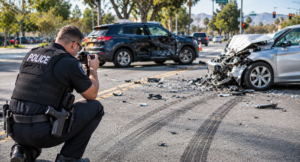 Determining a vehicle’s speed after an accident may require more than looking at the damage. Investigators may examine multiple sources of information to understand how the collision occurred.
Potential evidence can include:
- Skid marks
- Tire marks
- Vehicle damage
- Vehicle resting positions
- Debris patterns
- Traffic-camera footage
- Dashcam footage
- Surveillance video
- Witness statements
- Event data from a vehicle
In more complicated crashes, accident reconstruction specialists may analyze physical evidence to estimate vehicle movements, impact points, and other crash characteristics.
Evidence That May Help Establish Speed
Evidence should be preserved as soon as reasonably possible because some information can disappear over time. Skid marks can be removed when a roadway is cleaned or traffic resumes. Surveillance footage may also be overwritten depending on the system used by a business or public agency.
Photographs should capture the overall scene as well as details such as damaged vehicles, roadway markings, debris, traffic signals, and visible tire marks.
Witnesses may also provide useful information. Someone who saw a vehicle immediately before impact may have observed whether it appeared to be traveling unusually fast, weaving through traffic, or making an unsafe maneuver.
Can a Police Report Establish Speeding?
A police report can provide valuable information about an accident, but the report may not contain every detail needed to determine liability. Officers may document statements, roadway conditions, visible damage, citations, and their observations at the scene.
A citation for speeding or another traffic violation may become relevant evidence, but a citation does not necessarily resolve every question about civil liability or damages.
Other evidence may need to be considered alongside the police report to establish how the collision happened.
Speeding and Comparative Negligence
California follows comparative negligence principles in personal injury cases. If multiple parties contributed to a collision, responsibility may be divided based on the circumstances.
For example, a speeding driver may argue that another motorist made an unsafe turn. An injured person may also face allegations that their own conduct contributed to the accident.
Our guide to comparative negligence in Riverside accident claims explains this concept in greater detail.
Speeding and Pedestrian Accidents
Speed can be especially important in collisions involving pedestrians. A driver approaching a crosswalk at an excessive speed may have less opportunity to recognize and respond to a person crossing the roadway.
The Riverside County Sheriff’s Office has recently emphasized pedestrian safety as part of its traffic-enforcement efforts. Its National Pedestrian Safety Month information encourages drivers to slow down around intersections, crosswalks, schools, neighborhoods, and areas with heavy foot traffic.
For more information about pedestrian-specific claims, see our article on pedestrian accidents in Riverside County.
Speeding and Bicycle or Motorcycle Crashes
Cyclists and motorcyclists may face serious consequences when a speeding driver fails to recognize them in time. A collision can throw a rider onto the roadway or cause the rider to collide with another vehicle or fixed object.
Evidence such as helmet-camera footage, bicycle damage, motorcycle damage, traffic-camera recordings, and witness statements may help explain how a crash occurred.
You can learn more about bicycle-related collisions in our guide to bicycle accidents in Riverside County.
What to Do After a Speeding Accident
Get Medical Attention
Anyone injured in a crash should seek appropriate medical attention. Some injuries may not be immediately apparent, particularly after a high-impact collision.
Report the Accident
Contact law enforcement when appropriate and preserve information about the responding agency and accident report.
Document the Scene
Take photographs and videos of the vehicles, roadway, traffic signs, signals, debris, skid marks, and surrounding area when it is safe to do so.
Identify Witnesses
Obtain contact information from people who witnessed the crash. Witness observations may become important if the drivers provide conflicting accounts.
Preserve Records
Keep medical records, bills, insurance correspondence, repair estimates, photographs, videos, and other documents related to the collision.
Insurance Claims After a Speeding Crash
Insurance companies may investigate whether a driver was responsible for a collision and what injuries or losses resulted. They may review police reports, medical records, vehicle damage, witness statements, and other available evidence.
If the driver who caused the accident does not have enough insurance coverage, additional insurance issues may arise. Our article about being hit by an uninsured driver in Riverside County discusses uninsured-motorist considerations.
Riverside’s Current Speed-Safety Efforts
Speed enforcement is currently a significant traffic-safety focus in Riverside County. The Sheriff’s Office’s 2026 grant program includes targeted enforcement of speeding and other violations that contribute to crashes. The program is scheduled to run through September 2027.
The City of Riverside has separately identified 63 Safety Corridors where additional safety measures are planned. The city says these corridors were identified based on concentrations of severe injury and fatal crashes and will receive measures such as updated signage, pavement markings, and targeted enforcement.
These initiatives do not determine liability in an individual accident. They do, however, illustrate the continuing local focus on speeding and other dangerous driving behaviors.
When a Speeding Accident Becomes a Personal Injury Claim
A traffic collision may become a personal injury claim when another person’s conduct causes an injury and legally recoverable losses result. Medical treatment, lost income, property damage, and other consequences may become relevant depending on the circumstances.
California personal injury law can involve multiple issues beyond determining who caused the initial impact. Evidence, insurance coverage, comparative negligence, medical treatment, and filing deadlines may all affect a claim.
Our broader guide to personal injury laws in Riverside County provides additional information about the broader claims process.
Final Thoughts
Speeding and reckless driving can turn an otherwise routine trip through Riverside County into a serious collision. Higher speeds can reduce reaction time and increase the force of impact, while reckless maneuvers can create additional hazards for drivers, pedestrians, cyclists, and motorcyclists.
When a crash occurs, evidence can be critical. Photographs, witness statements, surveillance footage, police documentation, vehicle damage, roadway evidence, and medical records may help establish what happened and the consequences of the collision.
Riverside County and the City of Riverside are currently investing additional resources in speed enforcement and roadway safety. Understanding these local safety efforts, California traffic laws, and the evidence involved in a crash can help accident victims better understand the issues that may arise after a speeding-related collision.